
Nowadays, more and more electronic assemblies are sharing less and less space inside enclosures. At the same time, the power dissipation of many components is increasing. Without targeted thermal management, components overheat, age more quickly, or fail entirely.
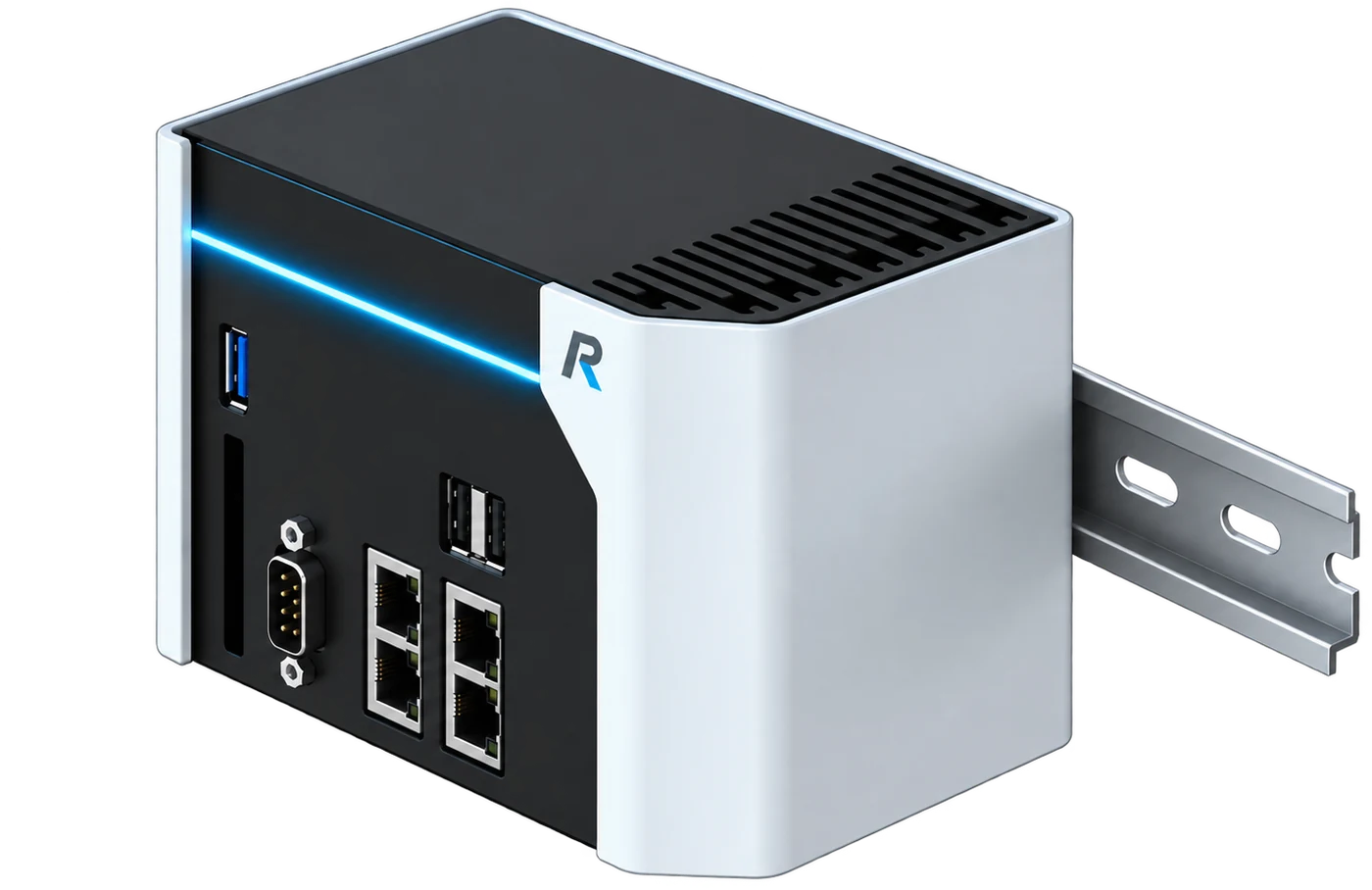
An " Case " doesn't just protect electronics from dust, moisture, or mechanical stress. It must also dissipate the generated heat in a controlled manner. If the internal temperature rises above the permissible range, the service life of the installed components decreases significantly.
Temperatures that are too low also pose risks. Condensation on cold components can cause short circuits and corrosion. A well-designed thermal management concept therefore takes into account both overheating and undercooling, as well as air quality, dust, and humidity at the site of operation.
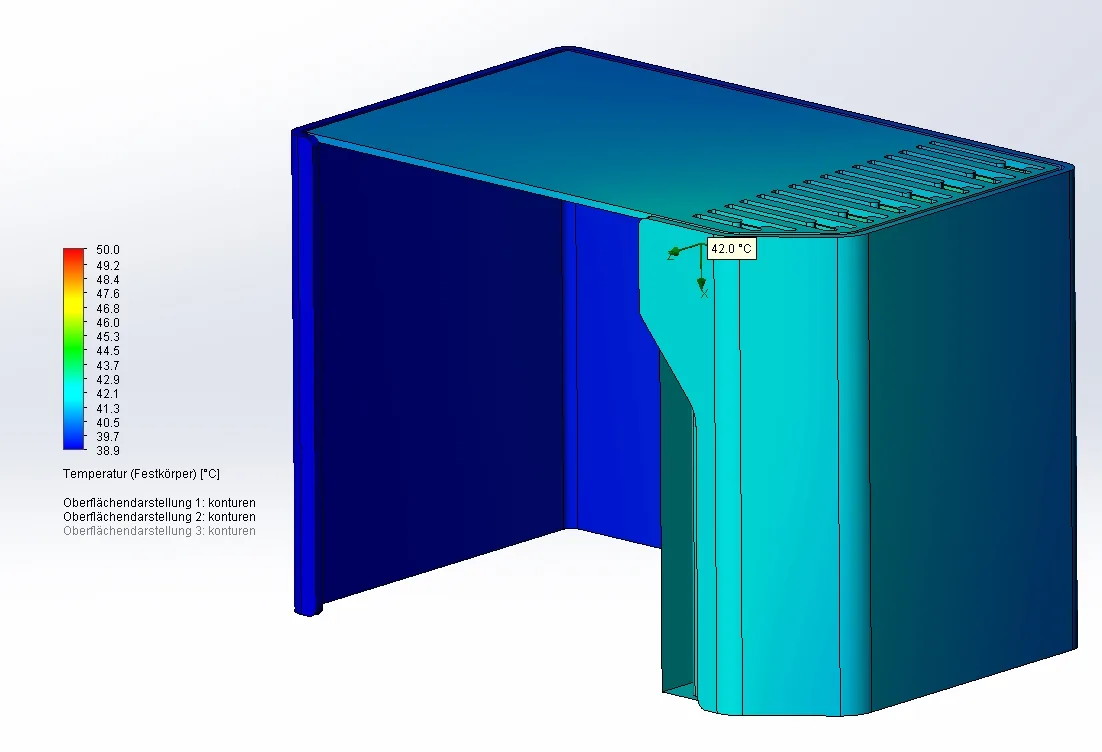
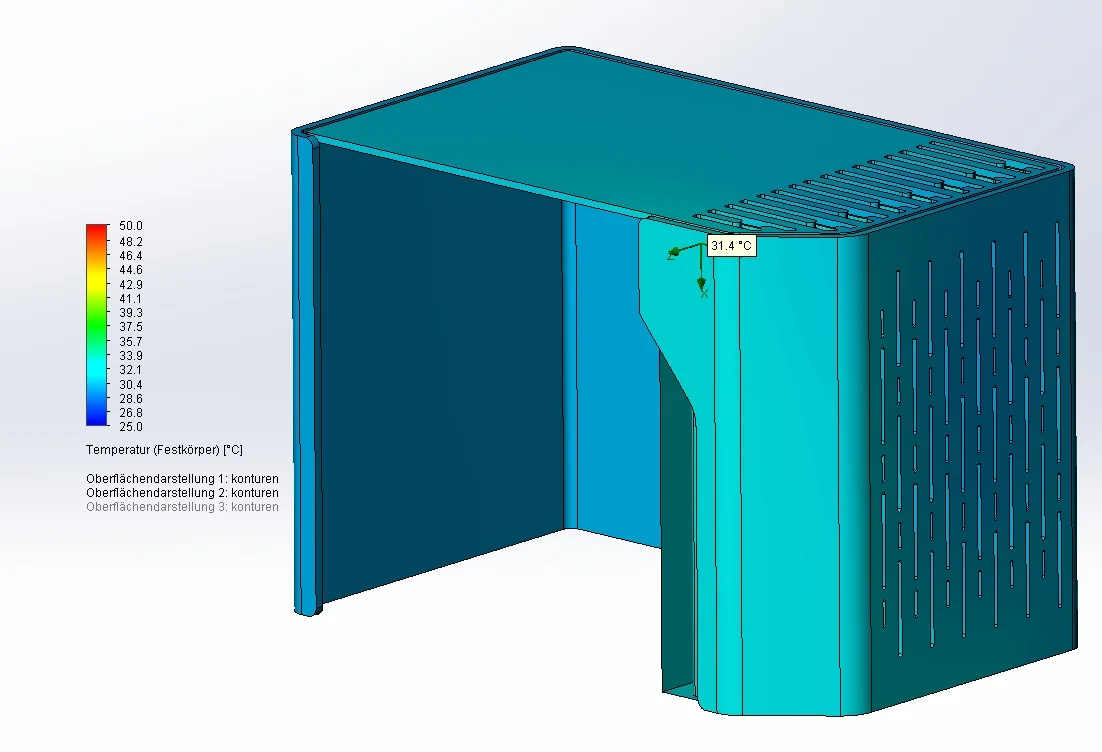
At POLYRACK TECH-GROUP , thermal management is not an afterthought, but an integral part of enclosure design. As a system supplier for custom solutions, the development engineers plan the thermal design from the very beginning, in conjunction with mechanical and electronic design and the desired protection rating.
This approach eliminates the need for later adjustments. As a result, cooling, enclosure geometry, and system engineering and electronics are designed to work together from the start, rather than being combined after the fact.
| Target (room temperature 25 °C) | IPC A , Material: Aluminum, , Power: 5 W (passive cooling) | IPC B , Material: Aluminum , Power: 15 W (active cooling) |
|---|---|---|
| Max. BGA temperature (°C) Surface temperature | 43,7 | 34,9 |
| Max. temperature Case (°C) Housing surface | 42,0 | 31,4 |
Maximum temperature according to UL requirements: 50 °C
Depending on the location, protection class, and heat generation, different cooling principles may be considered:
| Concept | How It Works | Typical Applications |
|---|---|---|
| Convection cooling | Heat dissipation through the housing surface, with no moving parts | Closed- Case s with moderate power dissipation |
| Forced ventilation | Fans actively expel warm air to the outside | High-density module carrier |
| Conduction cooling | Heat is dissipated through the heat sink and the housing wall | Dust-tight or hermetically sealed systems |
| Liquid/Hybrid Cooling | Combination of air and liquid cooling | Systems with very high power dissipation in a confined space |
The most appropriate design depends on the protection class, ambient temperature, and the power dissipation of the installed electronics. These factors are determined in collaboration with customers during the development process.
Many industries place particularly high demands on thermal management, such as rail technology, medical technology, and aerospace & defense. In these sectors, high ambient temperatures, vibration, and long operating times all come into play.
POLYRACK TECH-GROUP develops cooling solutions for, among other things, subracks in railway technology, measuring instruments in measurement, control, and regulation technology, and rugged Case in mechanical and plant engineering. Regulatory requirements and certifications are incorporated into the design from the very beginning.
The choice of material also Surface Finish affects thermal management. Metal enclosures generally conduct heat better than plastic ones. They can also be specifically combined with cooling fins or heat sinks.
POLYRACK TECH-GROUP 's in-house mechanical manufacturing facility makes it possible to integrate heat sinks, fan cutouts, and ventilation grilles directly into the chassis design, rather than having to adapt them afterward.
Thermal management encompasses all measures used to maintain the temperature inside an electronics enclosure within a defined range, such as through convection, forced ventilation, conduction, or liquid cooling.
As soon as the power loss generated in the Case can no longer be dissipated solely through the housing surface, an active cooling solution—such as forced ventilation or liquid cooling—becomes necessary.
Dust-tight or hermetically sealed Case s typically require conduction or liquid cooling, since fans would compromise the required protection rating.
Retrofit integration is possible, but it often results in compromises in terms of installation space and efficiency. Incorporating this consideration early in the development phase usually yields the more cost-effective solution.
These include, among others, railway technology, medical technology, measurement, control, and regulation technology, mechanical and plant engineering, as well as aviation and defense.

