
Choosing the wrong bus standard wastes development time if the backplane later cannot support the required data rate or is incompatible with the existing assembly. The VMEbus/VPX standard ensures that everything runs quickly and smoothly, even in challenging environments.
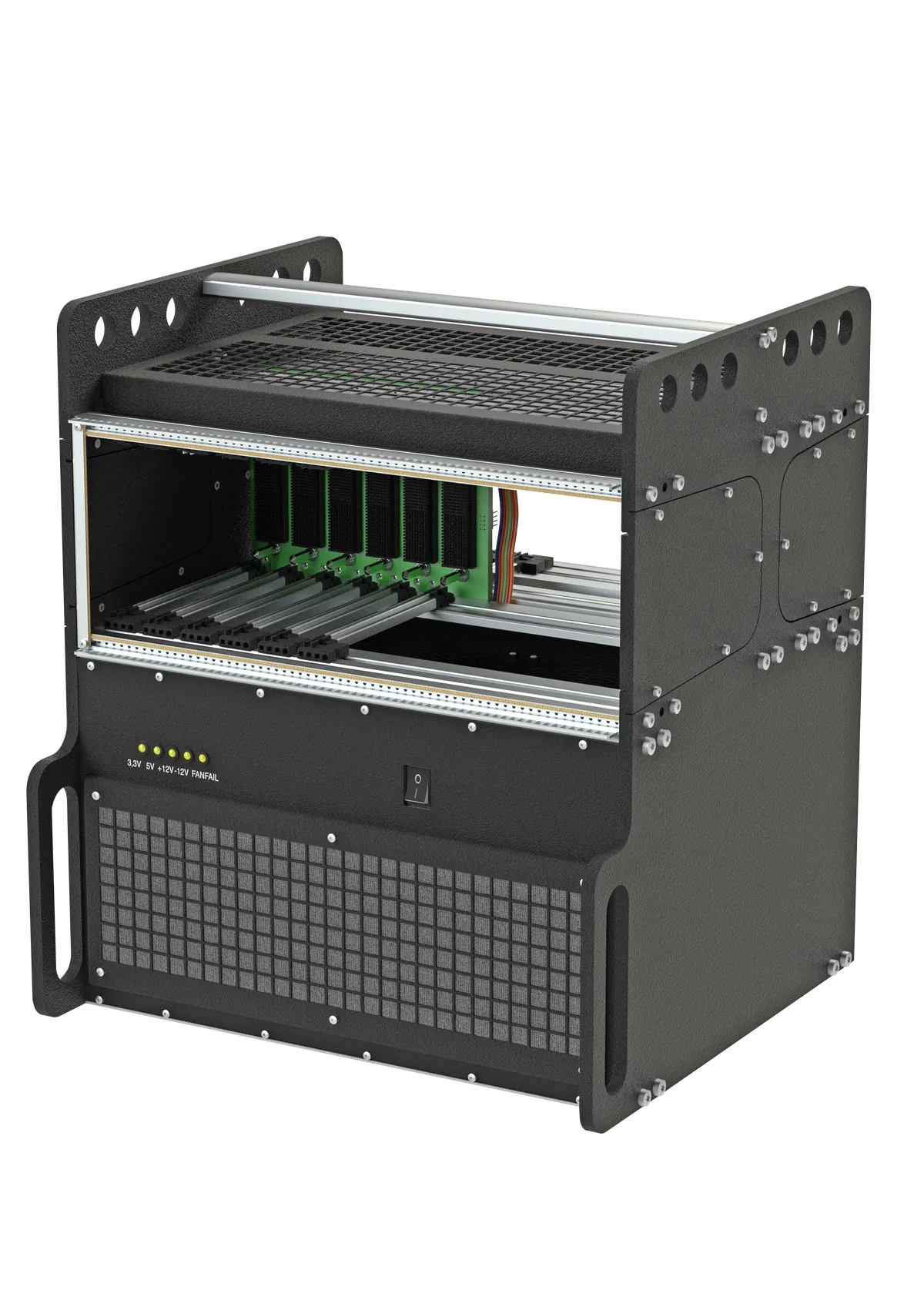
POLYRACK TECH-GROUP has been developing and manufacturing subracks and backplanes specifically for VMEbus and OpenVPX since 1979; more than 2,000 customers worldwide rely on this comprehensive system solution.
VMEbus is particularly well-suited for legacy systems and applications with moderate data rates, while OpenVPX is ideal for new developments requiring high data throughput.
POLYRACK positions OpenVPX as the direct successor to the VME64x: Its serial point-to-point architecture transmits data significantly faster, and its robust design makes it the preferred platform for rugged applications.
| Characteristic | VMEbus | OpenVPX |
|---|---|---|
| Basic Standard | ANSI/VITA 1-1994 | VITA 46.0, 46.10, 46.11, 65 |
| Data Transmission | in parallel via the J1/J2 bus board | serial, point-to-point |
| Height | 3U or 6U (monolithic) | 3U or 6U |
| Slots | up to 21 | depending on the backplane profile |
| Typical Applications | Legacy systems, moderate data rates | New Developments, Rugged Requirements |
When an existing VME system is being expanded or replaced, the established standard is usually retained because the large installed base facilitates retrofitting and the procurement of replacement parts, allowing proven modules to continue to be used without the need for redesign.
For new developments involving high data rates or rugged requirements, development teams today typically plan using OpenVPX.
POLYRACK develops and manufactures VME bus and Open VPX backplanes in accordance with international standards. Both standards can be customized to meet customer requirements. The use of high-quality base materials ensures reliable performance in the application.
For VMEbus, POLYRACK offers the J1 bus board in a 3-U configuration for 16-bit systems and the combined monolithic version in a 6-U configuration for 32-bit systems, along with active and passive bus termination and daisy-chain connectivity.
For OpenVPX, high-speed connectors such as EPT Velox or TE MultiGig are available upon request, as are VITA-48.2 versions for additional mechanical requirements. Various welding processes are used in our in-house manufacturing.
The product line includes the complete technical data sheets: VMEbus and OpenVPX backplanes.
VMEbus and Open VPX backplanes from POLYRACK’s standard product line are also catalog products that serve as development platforms: They provide the foundation and can be customized to meet the specific requirements of your application. Depending on your needs, the number of slots, connector configuration, layer structure, and mechanical interfaces can be customized.
If the customization options in the standard product line are insufficient—for example, in cases of significantly non-standard dimensions or requirements that fall outside the backplane profile—POLYRACK will develop the assembly from scratch. The path to achieving this is outlined in the program for custom Case and system solutions.
Technical data sheets and 3D design data in STEP format are available on the POLYRACK download portal; registration is free. Due to export control regulations, access is granted manually; in practice, developers retrieve the data several times a week for their own design work.
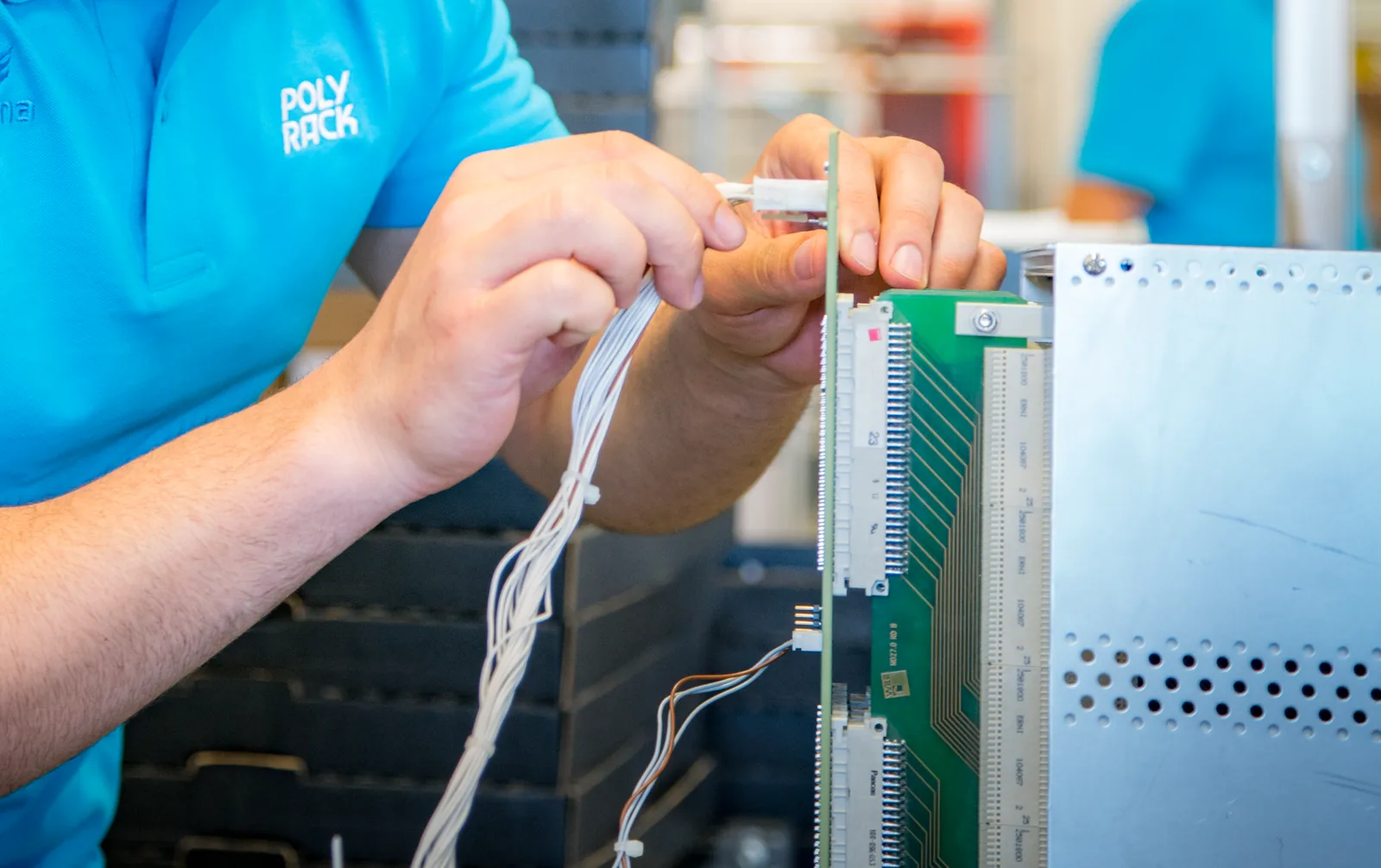
POLYRACK's VMEbus and Open VPX backplanes are used in applications where embedded electronics must operate reliably for years: in rail technology, measurement and control technology, and in aviation and defense applications with rugged requirements.
For measurement and control technology, long-term availability and a wide range of interfaces are particularly important, while for rugged applications, robust construction and vibration resistance are key.
POLYRACK's systems engineering and electronics bring together " Case " and "Baugruppe," regardless of whether a standard product serves as the basis or a new development is required.
VMEbus transmits data in parallel via a J1/J2 bus board, while OpenVPX operates serially via point-to-point connections. As a result, OpenVPX achieves significantly higher data rates and is considered more robust for rugged applications.
No. The two standards differ in terms of physical connectivity, so a VME system cannot be converted to OpenVPX without a new backplane. For new developments, POLYRACK provides advice on which standard is best suited to the planned data rate and expected service life.
Yes, with VMEbus and OpenVPX, the number of slots, connector configuration, and mechanical interfaces can be customized to suit your own module without requiring a completely new design.
The number of slots in the Open VPX backplane profile is based on VITA 65 and is customized for each project.
Data sheets and 3D design data in STEP format are available free of charge upon registration on the POLYRACK download portal. Due to export control regulations, access is granted manually.
Especially for railway technology, measurement and control technology, as well as aerospace and defense applications—anywhere embedded electronics must operate reliably and robustly for years.

